Emergency Fund Placement Options for MFD Client Portfolios
Determine emergency fund size first, then match instruments to each bucket's access needs.

Emergency corpus size before instrument selection
Get the size right before touching the fund list. That's the order, and MFDs who reverse it end up debating overnight versus liquid funds before anyone has settled the number those funds are meant to hold.
The textbook range of three to six months of essential expenses is a starting point, not an answer. A government or PSU employee, whose job carries close to zero layoff risk, can reasonably hold three months. A salaried employee at a stable private company should hold six. Anyone with irregular income, freelancers, commission-based earners, employees at early-stage startups, or a household running on a single paycheck, needs six to nine months, because the income gap after a job loss for this group runs longer and less predictably than the textbook range assumes. Clients carrying heavy EMIs or a home loan need six to nine months regardless of how stable their job looks, since the repayment obligation doesn't pause just because the income did.
"Essential expenses" needs a tight definition, or the whole exercise loses its point. Rent, groceries, transport, utilities, insurance premiums, and EMIs count. Dining out and streaming subscriptions don't count, and clients who blur that line end up either overfunding the corpus at the cost of long-term returns, or underfunding it because they never separated the two categories from the start.
Most clients are building a buffer from close to zero rather than fine-tuning an existing one. They're building one from close to zero, and the size conversation has to happen before the instrument conversation, not alongside it.
The three-bucket structure that determines which fund belongs where
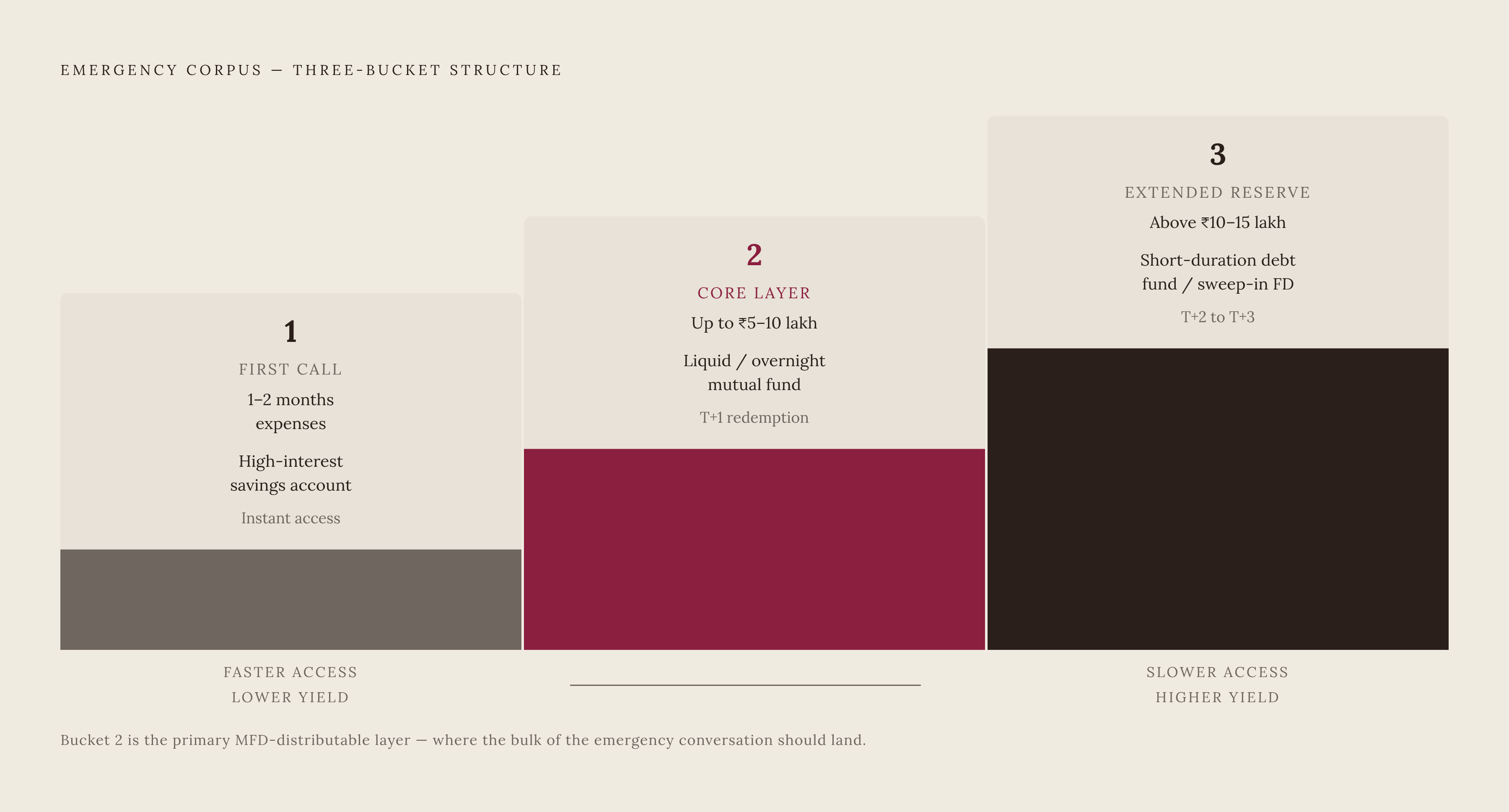
An emergency corpus is not one pool of money sitting in one account. Split it by how fast the client can reach it, not by which instrument pays the most; doing so makes the fund selection that follows close to automatic.
Bucket 1 covers one to two months of expenses and belongs in a high-interest savings account, ideally at a bank separate from the client's salary account. Only speed matters here, whether it is a hospital deposit at 11 p.m., an ATM withdrawal, or an EMI that needs covering before a late fee hits. Yield is a rounding error next to that.
Bucket 2 holds the remaining months of the corpus, up to roughly ₹5 to 10 lakh, where liquid or overnight mutual funds do their work, with T+1 redemption putting cash in the client's account the next working day. This is the core MFD-distributable layer. For most clients, the bulk of the emergency conversation should land here, and nowhere else.
Bucket 3 takes anything above roughly ₹10 to 15 lakh and can sit in a short-duration debt fund or a sweep-in FD, trading a day or two of extra settlement time (T+2 to T+3) for a bit more yield. Money in this bucket is unlikely to get touched in a genuine emergency, so the slower access costs nothing in practice.
Overnight funds: maximum safety, lower yield, right for specific client profiles
Overnight funds hold securities that mature in a single day, which pushes portfolio duration to effectively zero. Interest rate risk and credit risk both shrink close to nothing, because nothing in the portfolio stays outstanding long enough to be exposed to either. No exit load, and redemption settles T+1.
That safety costs yield. As of September 2026, overnight funds pay somewhere around 6 to 6.5%, running 50 to 75 basis points behind liquid funds. A direct plan of an overnight fund from Nippon India posted a 1-year return of 5.3%, a 3-year return of 6.2%, and a 5-year return of 5.7%, numbers that are at the conservative end of what the emergency-corpus conversation typically involves.
These funds fit a narrow client profile: someone who wants the absolute floor of risk on money they might need at any moment, and is willing to trade yield for that certainty. For most emergency corpus buckets, though, that trade isn't worth making. Liquid funds do the same job with a bit more return and barely any added risk. Overnight funds should stay the exception rather than the default recommendation.
Liquid funds: the workhorse of the emergency corpus for most clients
Liquid funds invest in money market instruments, treasury bills, commercial paper, certificates of deposit, capped at maturities of 91 days, with portfolio duration typically running 30 to 60 days. Redemption is T+1, so the client isn't giving up any access speed for the extra yield. That's the whole case for this category over overnight funds in one sentence: same speed, better return.
Scale backs that up. Liquid funds held ₹6.87 lakh crore in AUM as of July 2026, according to AMFI data, making them the largest mutual fund category in India by assets. That's not an accident of popularity. Institutional treasury managers use liquid funds as their operational cash reserve, parking corporate cash that needs to stay safe and available on short notice. If liquid funds are good enough for a company's own treasury desk, they're more than defensible as the default answer for a household's emergency fund.
Current yields across major fund houses are in a tight band: PGIM India Liquid pays 6.35%, Mirae Asset Liquid runs 6.28 to 6.34%, Aditya Birla Liquid is 6.39%, Axis Liquid is 6.37%, and Tata Liquid ranges 6.37 to 6.40%. The spread between the best and weakest of these is thin enough that which liquid fund an MFD picks barely matters. Whether the client is in a liquid fund at all is the decision that moves the needle.
Money market funds: the step up from liquid for clients with a slightly longer horizon
Money market funds extend the maturity ceiling to one year, against 91 days for liquid funds, which pushes portfolio duration meaningfully beyond what a liquid fund carries. That extra duration buys a marginally higher yield, but it comes with a cost a liquid fund doesn't carry: mild interest rate sensitivity. The NAV can move when rates move, something a liquid fund essentially never does at that scale, and clients need to hear that trade-off stated rather than buried in a yield comparison.
This fund fits the outer edge of Bucket 2 or the inner edge of Bucket 3, for money the client is unlikely to need within the next month or two but still wants inside a mutual fund rather than a bank FD.
It is not a replacement for liquid funds in the core emergency layer, and treating it as one is a mistake. The short duration of a liquid fund already lines up with how long a genuine emergency typically takes to resolve. Stretching duration out to six or eight months only pays off once the odds of needing the money in any given month are already low, so swapping the two categories in the wrong direction hands the client interest rate risk for no real benefit.
Ultra short duration funds: for the extended buffer that earns more but needs a day's notice
Ultra short duration funds occupy a duration band that sits above money market funds and below short-duration funds. No lock-in, and clients can redeem whenever they need to, but redemption takes at least a working day, fast enough for a planned expense and too slow for a 2 a.m. hospital bill.
The interest rate relationship here works the same way it does for any duration fund: NAV moves inversely to rates, so it falls when rates rise. Clients who hear "short-term" tend to assume that means no volatility. It's a mild risk, but a real one, and an MFD who skips that detail is setting a client up for a phone call the first time NAV dips.
A direct plan of an ultra short term fund from HDFC shows a 1-year return of 6.2%, a 3-year return of 7.2%, and a 5-year return of 6.4%, with an expense ratio of 0.4% and AUM of ₹15,950 crore. A direct plan of an ultra short duration fund from Nippon India runs slightly ahead: 6.8% over one year, 7.6% over three years, 6.9% over five years, with AUM of ₹10,200 crore. Both belong in the extended buffer, the cushion a client holds beyond the strict emergency definition, not the layer anyone taps at 2 a.m.
Arbitrage funds: a tax-efficient option for high-income clients on the outer portion of the corpus
Arbitrage funds buy in the cash equity market and simultaneously sell the same position in futures, capturing the price gap between the two. The strategy is market-neutral by design, so despite carrying an equity classification, return volatility stays low, closer in feel to a debt fund than to an equity fund.
That equity classification is the reason the fund appears in this conversation at all: it changes how gains get taxed. Short-term gains, held under a year, get taxed at 20%. Long-term gains, held over a year, get taxed at a preferential rate below the top slab, with an aggregate exemption threshold on top. A client at the 30% income tax slab holding a 7% FD to maturity pays tax at their full slab rate on every rupee of interest. The same client holding an arbitrage fund past twelve months pays 12.5% on the gain, and the exemption hasn't even been counted yet. On a post-tax basis, the arbitrage fund wins outright for anyone in that bracket.
The constraint that limits where this fits: the tax benefit only fully kicks in after twelve months of holding. That rules out Bucket 1 entirely, and it rules out the fast-access core of Bucket 2 too. Arbitrage funds belong on the outer edge of the corpus, money the client is confident won't get touched within a year, and they mostly make sense for clients in higher tax brackets, where the rate differential is large enough to matter.
What MFDs should avoid recommending
Most clients arrive at this conversation with their emergency money sitting in a regular savings account paying 2 to 4%. Pointing out that gap crosses no line: stating a fact about return is not the same as recommending a specific bank product.
Sweep-in or Flexi-FDs complicate the picture, since they pay 6.5 to 7.5%, offer instant ATM and UPI access, and carry DICGC deposit insurance up to ₹5 lakh. That combination makes them a genuine, competitive option for the instant-access bucket. An MFD should know the mechanics well enough to walk a client through them when the client brings it up. Recommending a specific bank's sweep-in product is where the line sits, and it sits outside what an MFD is permitted to advise on.
Benchmark FD rates put SBI at 5.65% for six months and 6.25% for one year, ICICI at 5.50% for six months, and HDFC at roughly 6.25 to 6.4% on a one-year term. Because bank FDs and liquid funds sit close enough in yield, the real choice between them comes down to access speed and tax treatment, not a dramatic gap in return.
An MFD who sizes a client's emergency corpus and then names a bank for the sweep-in FD has stepped into financial planning territory, and that step is the one AMFI's Master Circular exists to prevent. An MFD who explains that liquid, overnight, and ultra-short funds cover Bucket 2 and Bucket 3, and leaves the client's own bank to handle Bucket 1 without naming a product, has stayed inside incidental advice. The gap between those two conversations is narrow on paper and absolute in practice. Staying on the right side of it is what keeps the advice both useful to the client and defensible under the rule that governs the job.