TER Changes and Their Impact on MFD Trail Commissions
GST registration now determines MFD payouts on identical AUM.
SEBI's new mutual fund expense framework, in force since April 1, 2026, has rewired how distributors get paid based on whether the distributor is registered for GST, and under which scheme. The Base Expense Ratio (BER) structure pulled GST out of the commission envelope entirely, which means an unregistered MFD and a GST-registered MFD sitting on identical AUM books now walk away with meaningfully different money each month. This is not a rounding error. On a mid-sized book, the annual gap runs into lakhs of rupees, and the mechanism behind it is worth understanding in full before the next payout cycle lands.
How the old TER worked and what it concealed
Every mutual fund scheme, until this April, published one number: the Total Expense Ratio. It bundled everything, the fund manager's fee, the distributor's trail commission, and a pile of statutory charges, GST, STT, CTT, stamp duty, SEBI fees, exchange charges, into a single figure with no internal breakdown. An investor looking at the fact sheet had no way to tell how much of that TER was actual fund management cost and how much was tax being passed through.
That opacity had a quiet side effect on distributor payouts. Because GST on commissions sat inside the TER cap, AMCs paid out a GST-inclusive amount to every distributor, registered or not. An MFD who had never filed a GST return, who had no tax registration for indirect taxes, still received the same gross commission as a fully registered peer. The AMC simply absorbed the GST portion inside the overall cap and paid it out regardless of the distributor's tax status. It worked, in the sense that unregistered distributors were, in effect, pocketing a component of pay they were never legally entitled to receive as GST. Nobody was reconciling it against a tax invoice because the old structure didn't ask for one.
What the BER framework changed: the split between core costs and statutory levies
SEBI's fix was structural. The regulator introduced the Base Expense Ratio as the new capped metric, covering only core costs: fund management fees, distribution expenses, trade execution charges, and RTA charges. Nothing statutory sits inside BER anymore.
TER didn't disappear. It got redefined, because TER now means BER plus every statutory and regulatory levy attached to running the scheme. TER now means BER plus every statutory and regulatory levy attached to running the scheme, GST, STT, CTT, stamp duty, SEBI fees, exchange charges, all disclosed separately, on actuals, rather than folded into one blended percentage. Total Expense Ratio equals BER plus brokerage plus regulatory levies plus statutory levies. That's a wider number than BER alone, but it's transparent in a way the old TER never was. An investor can now see what portion of the cost is fund management versus what portion is tax the government is collecting regardless of anyone's performance.
For distributors, this split is the whole story. Trail commission comes out of BER. GST on that commission is no longer bundled inside the cap; it's a statutory add-on, paid separately, and only to distributors who can legally invoice for it.
New BER caps by fund category and their practical ceiling on commission room
The BER caps themselves came down across the board, which tightens the pool AMCs have to work with before commission is even calculated. Equity open-ended schemes with AUM under ₹500 crore now cap at 2.10%, down from 2.25%. Debt open-ended schemes in the same AUM band dropped to 1.85% from 2.00%. At the top end of the scale, equity mega-funds, those crossing ₹50,000 crore in AUM, face a BER ceiling of just 0.95%.
The pattern is consistent: bigger funds, tighter caps. That's by design, since economies of scale are supposed to translate into lower costs for investors as AUM grows. But it also means the largest funds, the ones many MFDs rely on for volume, have the least room inside BER to support distribution costs. Commission structures on mega-funds were already thin; this compresses them further.
How trail commission is calculated and paid each month
Trail accrues daily. Each AMC runs an end-of-day calculation on every investor's AUM sitting under a distributor's ARN code, and that accrual sits as an internal accounting entry, not yet payable, not yet cash.
At month-end, the AMC consolidates that accrued commission across every client and every scheme the distributor services, layers in any B-30 incentive that applies, and produces a payout report. Section 194H requires TDS deduction before anything moves, so that comes off next. What's left is paid to the distributor's bank account somewhere between T+25 and T+45 from month-end, with most AMCs settling inside the 30-to-45-day window from the close of the accrual period.
None of that mechanical sequence changed on April 1. What changed is what's inside the number being accrued.
What GST delinking means for unregistered MFDs in rupees
Starting with the May 2026 payout cycle, unregistered MFDs receive only the base commission, roughly 84.75% of what they would have received under the pre-April structure. The remaining 15.25%, the GST component, no longer moves to them. AMCs will only release that portion against a valid GST invoice, and an unregistered distributor cannot issue one.
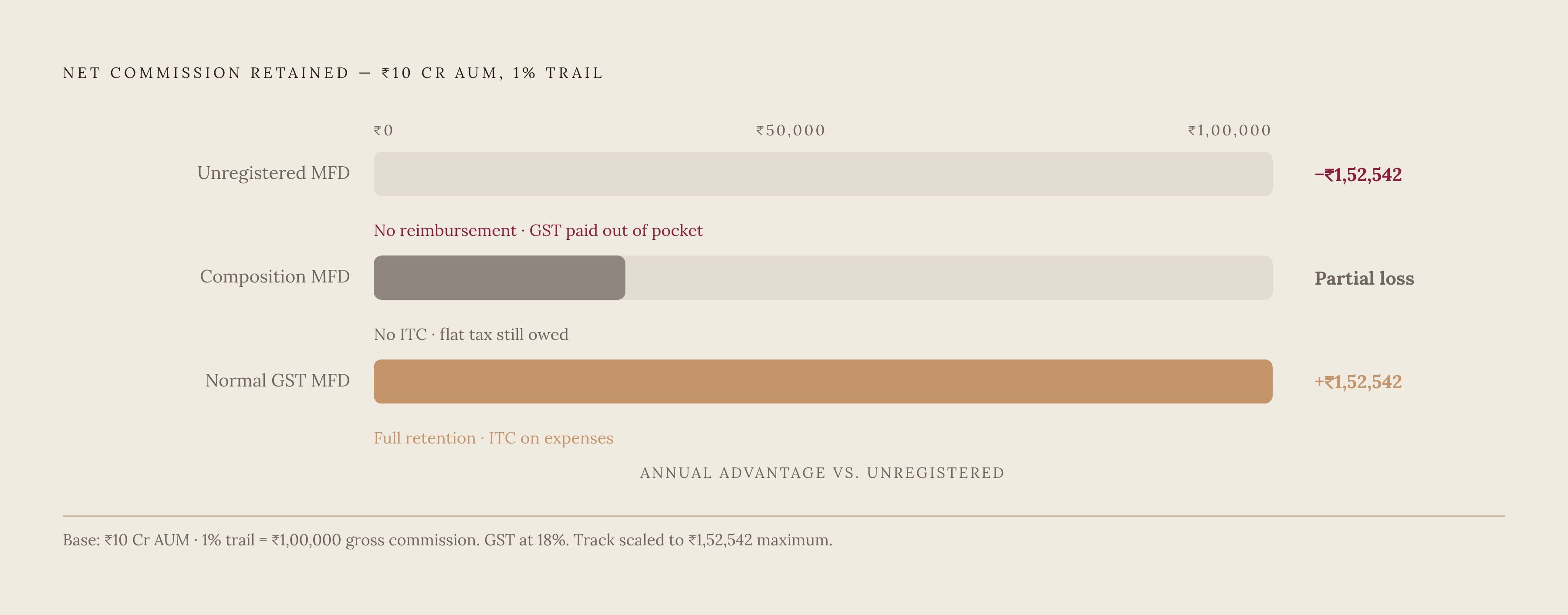
Put in rupees: a distributor holding a ₹10 crore AUM book at a 1% trail rate now loses ₹1,52,542 a year, money that used to arrive automatically and now simply doesn't. Scaling that down to a more typical practice generating ₹5 lakh in annual commission puts the shortfall somewhere between ₹76,000 and ₹90,000. For a distributor running a small, largely retail practice, that's not a rounding adjustment, that's a meaningful percentage of take-home income evaporating because of a tax-registration status that, until this April, made no financial difference.
The composition scheme trap: why the low-paperwork GST option now backfires
A lot of smaller MFDs chose the GST composition scheme years ago, and for good reason at the time. It's simple: pay a flat percentage on turnover, skip the Input Tax Credit paperwork, skip the monthly reconciliation headache. For a one-person distribution practice with no accounting staff, that simplicity was worth something.
It now works against them. AMCs will only reimburse the GST component at the full 18% rate, and only against a valid tax invoice. A composition scheme MFD cannot issue an 18% tax invoice, full stop, they issue a "bill of supply" instead, which carries no GST charge on its face. So the AMC treats them exactly like an unregistered distributor: base commission only, no GST reimbursement. But the composition scheme MFD still owes the flat composition tax on their turnover, paid out of pocket, regardless of what the AMC does or doesn't reimburse.
Run the numbers before and after: the reversal is stark. Before April 2026, the composition scheme could leave an MFD ahead of the normal 18% GST scheme on a large enough commission book, since the composition rate was lower and the AMC paid the same gross amount either way. After April 2026, the normal scheme pulls clearly ahead. The difference across a single tax year, on the same book of business, can be significant, driven entirely by which GST scheme a distributor happened to pick, likely years before anyone imagined this framework existing.
How GST-registered MFDs on the normal scheme fare and why the clawback clause matters
A distributor registered under the normal 18% GST scheme comes out whole, at least on paper. On submission of a valid tax invoice, the AMC pays base commission plus the full GST component, so gross receipt is unchanged: ₹1,18,000 for every ₹1,00,000 of base commission. After remitting ₹18,000 to the government, the distributor retains the same ₹1,00,000 they'd have kept under the old bundled TER.
Registered MFDs get an additional lever unregistered and composition-scheme distributors don't have access to: Input Tax Credit. Office rent, internet bills, laptops, software subscriptions, travel to client meetings, all of it can offset GST liability, lowering the net amount actually remitted. Over a full year, that's a real reduction in cash outflow that has nothing to do with commission structure and everything to do with running the practice like a registered business.
There's a catch built into every distribution agreement, though, and it's not a small one. There's a clawback clause built into every distribution agreement: if the AMC pays out the GST component but that invoice never appears in the distributor's GSTR-2B filing, the AMC can pull that amount back out of the next payout. So GST compliance now functions as a direct precondition for keeping income already received, not just a background administrative task. File late, file incorrectly, or mismatch an invoice, and the money that already landed in the bank account can leave again.
When GST registration becomes mandatory and when voluntary registration pays for itself
The mandatory threshold sits at ₹20 lakh in aggregate annual commission income for MFDs. Below that line, registration is a choice, not a legal obligation.
The threshold calculation trips up distributors more often than it should, because aggregate turnover is PAN-linked, not business-linked. Insurance commission, financial planning fees, any other service income earned under the same PAN, all of it counts toward that ₹20 lakh figure. A distributor who assumes their MF commission alone keeps them under the limit can find themselves over it once every income stream is added up.
Even below the mandatory threshold, voluntary registration increasingly pays for itself. On ₹15 lakh in annual commission, an unregistered MFD leaves roughly ₹2.29 lakh on the table, GST reimbursement that simply never arrives. For most small practices, that foregone amount alone exceeds whatever it costs to register and file GST returns properly, before even counting the ITC benefit on rent, internet, and software that registration unlocks.
The B-30 and new women investor incentive as a partial offset
SEBI built in one cushion against all this compression. Effective March 1, 2026, AMCs can pay MFDs an extra 1% incentive on the first lump sum or the first year of SIP contributions for onboarding a new individual investor, identified by a fresh PAN, from a B-30 city, or a new woman investor from any city in the country. The incentive is capped at ₹2,000 per investor.
It's a real offset, but a partial one, aimed squarely at expanding the investor base outside the top 30 cities and widening participation among women investors, not at compensating for the GST delinking broadly. For a distributor whose book skews B-30 and who's actively bringing in new PANs, it helps close some of the gap. For a distributor sitting on an existing, mature book of investors from smaller cities and towns, it does nothing, because the incentive only applies to new onboarding, not to AUM already on the books. The GST registration decision remains the far bigger lever for most distributors, and the one within their direct control.