SIP Stoppage Detection and Reactivation in Client Portfolios
Stopped SIPs hold capital; advisors who understand why can save relationships.

A stopped SIP is a discontinued instruction sitting on top of a folio that still holds every unit ever purchased, still compounding, still fully redeemable, by default. It is a discontinued instruction sitting on top of a folio that still holds every unit ever purchased, still compounding, still fully redeemable. The distinction matters because the industry keeps reporting stoppage numbers that sound catastrophic and behaving as though every one of them represents money walking out the door, when the real story is about instructions lapsing, not capital fleeing. For an advisor whose only payout since SEBI banned upfront commissions is trail on assets under management, understanding why an SIP stopped can turn a five-minute fix into a saved client relationship, or its absence can quietly end one.
The scale of the problem: what AMFI data from 2021 to 2026 shows
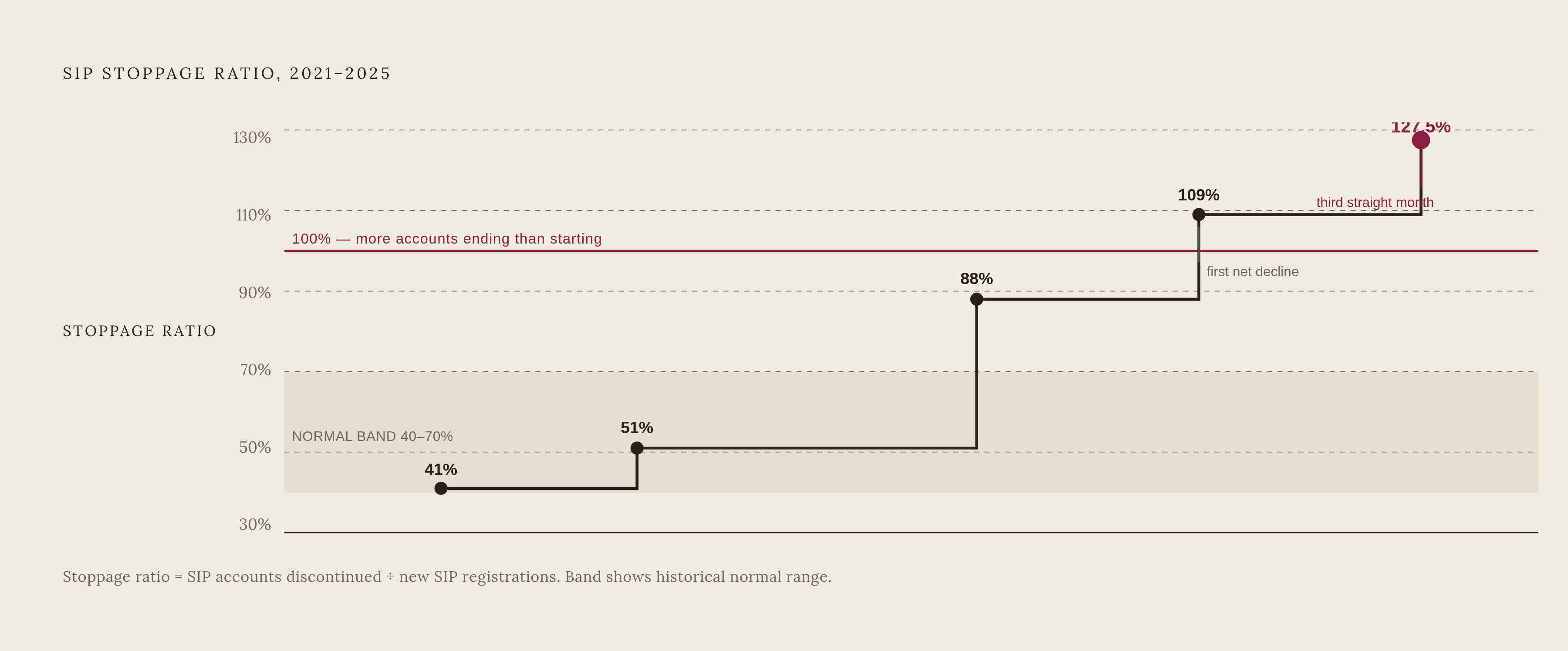
The SIP stoppage ratio is a simple calculation: SIPs discontinued or completed in a month, divided by new SIPs registered in that same month. When the ratio crosses 100%, more accounts are ending than starting, and that threshold has become a lot more common than it used to be.
In 2021, the ratio sat at 41% for the full year. By 2022 it had climbed to 51%, and for a couple of years that 40-to-70% band looked like the normal range, the background noise of a maturing SIP market where completions and early exits balanced out against a steadily growing base of new registrations.
Then came May 2024, when the ratio touched 0.88, well above the long-run average of roughly 0.51, a record high much above the long-run average of roughly 0.51. The month before, April 2024, had looked comparatively calm: 63 lakh new SIPs registered against 33 lakh discontinued, a ratio near 52%. The spike that followed showed how quickly sentiment can move the number.
January 2025 marked something different: outstanding SIP accounts actually fell, from 1,032.03 lakh to 1,026.89 lakh, the first net decline in years. The stoppage ratio surged to 109%, up from 82.7% in December 2024, with 56 lakh new SIPs created against 61 lakh stopped. March 2025 pushed the trend further, with 51 lakh SIPs discontinued and the ratio hitting 127.5%, marking the third straight month where closures outran new sign-ups. That is not a blip. That is a pattern holding across a full quarter.
Why high inflows and high stoppages coexist
A lot of people reading the headlines get confused here: SIP inflows have stayed above ₹31,000 crore in multiple months across 2025 and 2026, SIP AUM is ₹16.85 lakh crore, and stoppage ratios are still crossing 100% in the same stretch. Both of these facts are true at once, and neither cancels the other out.
SIP AUM as a share of total industry AUM has barely moved over twelve months, holding between 20.16% and 20.73%. That is a steady share of the pie, not a growing one, which tells you something the headline inflow figures don't.
The likely explanation is a narrowing base carrying a stable total. Higher-value, higher-conviction investors appear to be maintaining or even increasing their contribution sizes, while a portion of accounts churn out. Aggregate rupees hold steady, but the number of people actually participating quietly shrinks. Call it a wealth transfer, in effect: as stoppages keep outpacing registrations, AUM concentrates further among the investors who stay, while a portion of accounts exit into weaker market conditions and do not return.
The identifiable patterns behind why clients stop SIPs
Five separable causes explain most SIP stoppages, and treating them as one undifferentiated problem is the single biggest mistake an advisor can make in a reactivation workflow. Each cause needs its own read and its own response.
Market fear and behavioural reaction is the most common, and it appears directly in AMFI's monthly figures: stoppage ratios rise after weak market stretches and fall after strong ones. Investors systematically stop buying when prices are down and resume once prices have already recovered, which is the exact opposite of what a systematic investment plan is designed to do. Earlier market shocks, such as March 2020, provide historical context for how sharply stoppage ratios can spike when panic sets in. Dennis Gabriel, partner at Upwisery, said in Business Standard: "Consistent market corrections and the amplified noise around them increase the fear of worst-case scenarios." Finnovate's analysis points to sustained FPI selling and prolonged flat-to-negative mark-to-market returns since the Nifty 50's September 2024 peak as the proximate driver behind the 2025-26 pressure, and That prolonged flat-to-negative mark-to-market experience, visible in any portfolio statement, likely weighed on investor conviction.
Mandate and payment failure is mechanical, and it gets misread as investor intent far too often. An SIP can discontinue automatically after a series of consecutive failed transactions, depending on the plan type. The usual triggers are mundane: insufficient balance on the debit date, a NACH mandate that expired or got modified, a bank account switch, a blocked debit flag. The tell is simple. If the client never submitted a stop request and the discontinuation just appeared, the cause is almost always the plumbing, not any judgment about the fund.
Genuine cash-flow pressure covers medical emergencies, job loss, a delayed bonus, an unplanned large expense. These are real reasons to pause, and they usually point to a missing emergency fund rather than a flawed investment strategy. A study hosted on Zenodo, covering 152 first-time investors, found personal financial emergencies among the primary catalysts for attrition, alongside loss aversion and the absence of human advisory support on digital-only platforms. More striking: 52.6% of participants in that study had either paused or permanently discontinued their investments, which suggests this is not a fringe problem confined to a small slice of the client base.
Building a detection workflow: how advisors identify stoppages before they become permanent
AMFI's monthly published data on SIP accounts registered, discontinued, and contributing is the starting point. It's an industry-level signal, but it functions as an early-warning calendar: months where the national stoppage ratio spikes are months to expect elevated stoppage risk in any individual advisor's book too.
The gap between "contributing" and "registered" accounts is where client-level detection actually happens. Not every registered SIP contributes in a given month. AMFI data shows roughly 70-80% of active accounts contributing to monthly inflows in normal conditions, and a high contributing ratio at the client level is a sign of healthy, active funding. In February 2025, for instance, contributing accounts numbered around 82.6 million out of 101.7 million active SIP accounts. That gap between total registered and total contributing is the detection window, the space where an advisor can catch a problem before AMFI ever logs it as an official discontinuation.
Practically, this means scanning portfolios for any account where a debit has not shown up in the current cycle. Catching that early intercepts mandate failures before they stack up to the three-failure threshold that triggers automatic discontinuation, turning a preventable lapse into a five-minute mandate fix instead of a lost client.
Layer a volatility calendar on top of that. Because stoppage ratios move in step with market sentiment, rising after drawdowns and easing after rallies, the pattern is predictable enough to plan around. Scheduling outreach in the weeks following a significant market drop, rather than waiting for a client to call in a panic, converts a documented statistical tendency into a proactive workflow.
Matching the intervention to the cause: what the right reactivation response looks like for each stoppage type
A mandate failure calls for a mechanical fix and nothing more: verify NACH mandate status, check the account balance on the debit date, confirm there wasn't a bank account change. Reactivation means submitting a fresh SIP registration or reinstating the mandate. The conversation is short, and it doesn't need to touch on investment strategy at all, because nothing about the fund choice was ever in question.
A behavioural stoppage driven by market fear needs a different kind of conversation, one that doesn't argue with the emotion but makes the cost of inaction concrete. The investor stopped buying precisely when prices were lower, which undercuts the entire mechanism an SIP is built on. Rupee cost averaging works because continued contributions during a drawdown buy more units at a lower NAV; stopping during the dip and resuming after prices recover reverses that advantage entirely, this is the "don't lose rupee cost averaging" framing that Business Standard's reporting on the topic emphasizes. The least destructive first move is often to reduce the SIP amount rather than kill it outright: a smaller SIP keeps the habit and the mandate alive. Reactivation itself is usually straightforward, a fresh SIP registration for the same scheme through most platforms, though a mandate that lapsed after a long gap will need a new NACH setup. Either way, the units purchased earlier stayed invested the whole time, regardless of how long the gap ran.
Genuine cash-flow pressure calls for restraint. The reason should be validated, and reactivation shouldn't be forced while the client's liquidity is still stressed. Where available, the SIP pause facility is the right tool, allowing the investor to resume contributions once their situation stabilises. The deeper fix, though, is diagnostic. A cash-flow stoppage is often a symptom of a missing or thin emergency fund, and addressing that underlying gap is a long-term retention measure, not just a courtesy. Get that buffer in place and the next market correction doesn't force another stop.
Goal completion or a life-event change needs a check-in before anything else: was the goal actually achieved, or did the client stop early out of frustration dressed up as completion? If the goal genuinely closed out, the conversation shifts to what comes next, setting up a replacement SIP so the relationship, and the trail, carries forward on new terms. If the change is a life event instead, an NRI relocation, a major reallocation, the conversation is a portfolio review. It's a portfolio review, and the advisor's job there is to help redesign the plan, not just switch the old one back on.
The communication approach that turns a stoppage conversation into a retention conversation
The cause of the stoppage should decide the tone of the outreach before a single word gets written. A mandate failure needs a short, functional message: something failed, here's the fix, done. A market-fear stoppage needs a conversation grounded in the mechanics of rupee cost averaging, not reassurance about market timing, because the investor already knows markets are volatile; what they need is the specific, numerical case for why stopping now locks in the wrong side of the averaging effect. A cash-flow stoppage needs patience and a pause option offered before a reactivation pitch, because pushing money conversations on someone mid-emergency reads as tone-deaf at best.
None of this works as a script. It works as a sequence: detect early using the contributing-versus-registered gap, diagnose the specific cause rather than assuming panic or apathy, then match the intervention to what actually happened. A stopped SIP, handled this way, is a lapsed instruction on an intact investment. It's a lapsed instruction on an intact investment, and in the overwhelming majority of cases documented across mandate failures, market fear, and cash-flow strain, it's recoverable, provided someone catches it before the gap turns into permanent silence.